Questions about exceptionalism, care, multiplicity, and hope
An Attention Inventory from Katie Hoeberling, OEDP's Deputy Director


Throughout the year, a different OEDP team member shares a list of what they’re paying attention to—whether big topics or small, these “attention inventories” outline a few of the ideas that shape our work, but don’t necessarily show up in the policy memos or playbooks we write. These inventories will feature the ideas that flit persistently between the front and back of our minds. They’re our thoughts on the browser tabs, the newspaper headlines, the sections of the bookstore that we keep coming back to, again and again.
This month’s Attention Inventory is compiled by Katie Hoeberling, Deputy Director at OEDP.
I will preface this with a note that I haven’t been in a particularly inspired mood lately. Good things are happening at OEDP for sure, and I’m personally doing okay. But it hasn’t gotten any easier to watch this administration, spurred on by corporations, dismantle the institutions, which, while imperfect, held some semblance of a line against free-for-all extraction and pollution and war. My attention has been… chaotic and sporadic. But I’m piecing things together and trying to ask good questions. Here’s what that’s looked like lately:
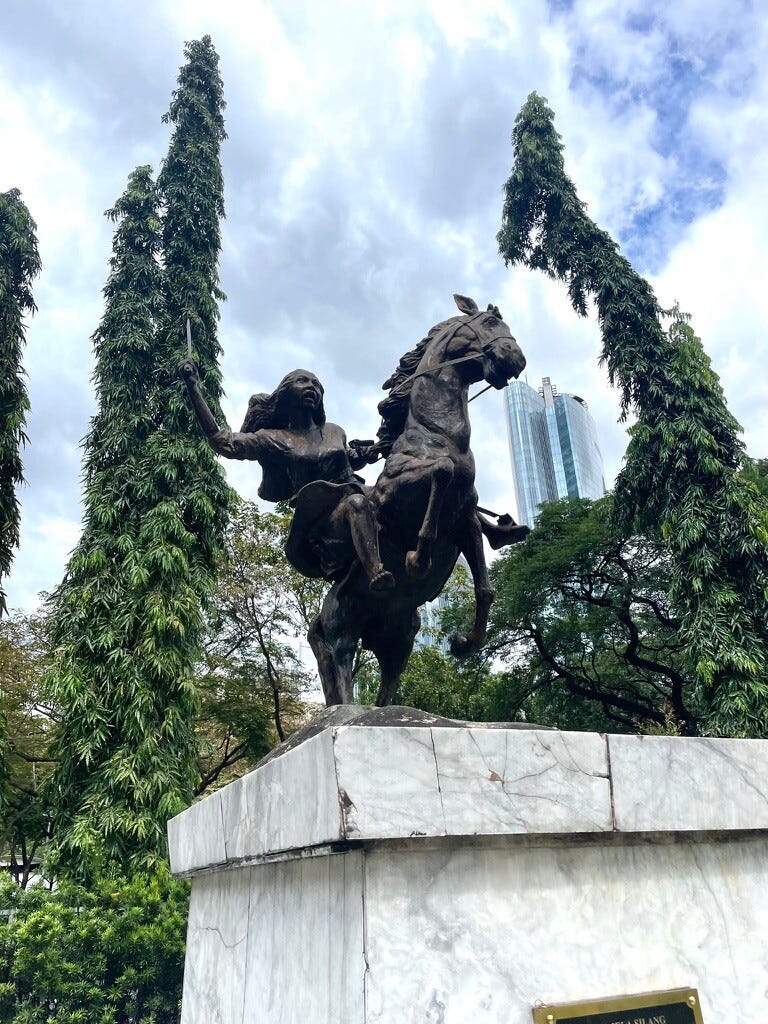
What can we learn when we put aside American exceptionalism?
I had the immense fortune and privilege to spend much of winter traveling in Asia—to the Philippines for holiday celebrations with family, to south India for a dear friend’s wedding, and to Singapore and Sri Lanka for fun (and food). My favorite way to pass time on long haul flights is to read about where I’m traveling, so I brought “How to Stand Up to a Dictator.” Maria Ressa’s memoir of her career in journalism throughout Southeast Asia is also a personal recounting of how Facebook has enabled authoritarians to spread disinformation and consolidate power (from Duterte and Bongbong Marcos in the Philippines to Putin in Crimea and Russia). It was an enlightening and frustrating read, not just because Meta continues to enable the manipulation of public opinion and spread of disinformation, but because Ressa points to so many signs and opportunities we’ve had to prevent Big Tech from steering our recent elections.
Traveling and reading made good reminders of how easily we as Americans fall into the trap of exceptionalism. The word “unprecedented” has become ubiquitous in our media and discourse. And I worry that this thinking blinds us to things we can learn from people and places that have already experienced what feels unprecedented for so many of us. What might we be missing or dismissing? Ressa’s experience and frameworks for ‘standing up to dictators’ could be really useful for resisting the Trump administration and thinking about the stakes of the midterms. For example, the coalition-based #FactsFirstPH approach spearheaded by Rappler (the Filipino digital media company Ressa co-founded), mobilizes journalists, communities, researchers, and attorneys in defending against disinformation, especially ahead of elections. Each group has different but interlocking roles: fact-checking, “algorithmic amplification,” data analysis, and legal protection. If federal and state governments in the US can’t (or refuse to) regulate big tech, what roadmaps can we create for ourselves so we can organize around, and in spite of, them to maintain integrity in our elections?
What creates the conditions for memory and attentive, careful work?
Less than 20 hours prior to arriving at Changi Airport and taking a Grab taxi to a 23-hour Chinese restaurant that served some of the best dumplings I’ve ever had, I was at home in Oakland trying to remember what I’d forgotten to pack (a hairbrush, it turns out). Oakland is a vibrant and beautiful, if rusty, place I’ve been proud to call home for almost a decade. It can also be hard to walk around the city and not feel dismay at the underfunded transit infrastructure, overfunded surveillance infrastructure, and the relentless fights people take to defend their home encampments from being swept up. It was jarring to go from that to Singapore’s well-manicured parks and shiny financial district skyscrapers. I kept thinking “Who isn’t here anymore?” and “Who or what was sacrificed to make this world possible?” These questions ring just as true in the Bay as they did there. In the US, we seem to be in a perpetual state of cultural and institutional forgetting or erasure. Some of this is of course deliberate (deportations and “sweeps,” sanctions on free speech, data removals). But I think a lot of forgetting, institutional or otherwise, happens when we’re pressured to move too quickly or when our attention is captured for profit. I think about what conditions can enable more careful and deliberate work—work that honors and preserves memory, work that makes room for and intentionally integrates what we’ve learned. Speed and distraction threaten our capacity to care.
This is coming up a lot for me as OEDP deliberates on how we do and don’t want to interact with generative AI. We don’t subscribe to the narrative that AI ubiquity is inevitable or that we should allow AI to make decisions for us, but neither are we immune to the appeal of technology that would help a small, scrappy organization do more with the limited time and resources we have. I would love to be able to synthesize and write more quickly. But I also don’t necessarily think it should be easy. We’re grappling with complicated questions that deserve attention, care, and dare I say a little struggle. I recently listened to an essay by Stephanie Krzywonos where she talked about writing as thinking. This really resonated with me as someone who often uses writing to process my thoughts, and thinks of writing as a practice and a muscle. In fact, this newsletter was really hard for me to write. I felt out of practice. What will happen to this muscle if I cede the work, the practice of writing to a machine that cannot care?
In “Pedagogy of the Oppressed,” Paolo Freire says “I work, and working I transform the world.” If work = force x distance, then is using AI to generate writing (or anything else, really) the exertion of limited force over no distance at all? Meaning, are we forgoing work, and thus transformation, by wielding a technology that merely recreates the world as it already exists? If we need new (or previously disregarded) ideas, new ways of telling stories, renewed will to act on the things we know, I’m skeptical that LLMs are going to get us there. I will say I’m excited by some of the alternative, small, and local ways of engaging with AI that OEDP is exploring. Our Fieldnotes on AI series by Shannon, Cathy, and Emelia is a great example of how we can think curiously and critically about AI in environmental spaces.
How can environmental governance accommodate multiplicity?
The other thing I’ve been ruminating on lately—have been really since I started working in science and policy spaces—is how to build systems of data and accountability that can accommodate multiple ways of knowing. Community-collected data has long been a mainstay in conversations about environmental justice. Even as we’ve hyperfocused the last couple of years on protecting and stewarding government data, our partners and stakeholders continue to remind us that, as we re-build tools that have been deleted from public websites, we have an opportunity to do what governments, by and large, have not yet been able to: make room for community voice to meaningfully inform environmental decisionmaking.
These conversations tend to come back to standards—getting agencies to better communicate standards for data, resourcing community researchers to meet them, and building sensors and digital infrastructure that make it easy to collect and upload standardized data. Emelia (our Sr. Research & Policy Manager) and I wrote about this in 2024 and, even though EPA eliminated some of our target audiences (like the Office of Environmental Justice), I still believe state and local agencies could benefit from our recommendations.
But while we work towards standardization, we also have to keep fighting what our long-time collaborator Gwen Ottinger calls “scientific chauvinism.” Gwen describes this concept in detail in their new book, “The Science of Repair,” but to paraphrase here: scientific chauvinism is where researchers and governments privilege credentialed scientists as the sole definers of quality or valid evidence, often through data standards and other norms for knowing well. I’m still reading the book, but I’m encouraged by the possibility of a middle ground Gwen asserts: “We need to bring science into moral community.” Maybe science is limited in its ability to help environmental justice communities hold polluters accountable (at least on its own). But we can bring flexibility into our governance systems: for example, by adjusting the standards for evidence by which we assess the risk of harm to already overburdened neighborhoods—i.e., prioritizing public health significance over statistical significance. (I’m anticipating coming back to this as my own community gears up to try and stop the construction of a new coal terminal at the Port of Oakland. Yes, in 2026.)
None of this will be easy, but I’m emboldened by all the places where I see this conversation showing up, especially the new EJ Data & Mapping Society. We just had our quarterly general meeting—if you want to join the next one or one of the working groups we’re standing up, sign up here!
How do we hope when hope isn’t working?
I realize this wasn’t the most hopeful inventory, but it’s where my head and heart are lately. And honestly, hope isn’t really doing it for me right now anyway. If you’re in a similar boat, I’ll leave you with some righteously furious advice from one of my favorite writers Rebecca Solnit: “If the word hope doesn’t work for you, try ‘Never fucking surrender.’”
I, for one, am trying not to. As anxious and pessimistic as I am about the state of our country and the world, I’m still building new things with PEDP, yelling at OpenAI, going to musicals, and planting seeds (an admittedly hopeful act). This season I’m growing three Asian eggplant varieties, three tomato varieties, summer and winter squash, shiso, and marunggay (wish me luck, my uncle who runs a Filipino nursery out of his backyard warned me it won’t do well in a place as chilly as the Bay, but here we go anyway). I also recently became a proud Master Gardener of Alameda County, and am finally getting to tend to gardens in Oakland after so much travel. If you’re in the Bay next month, come say hi at West Oakland Farm Park!
Sincerely,
 | A guest post by
|